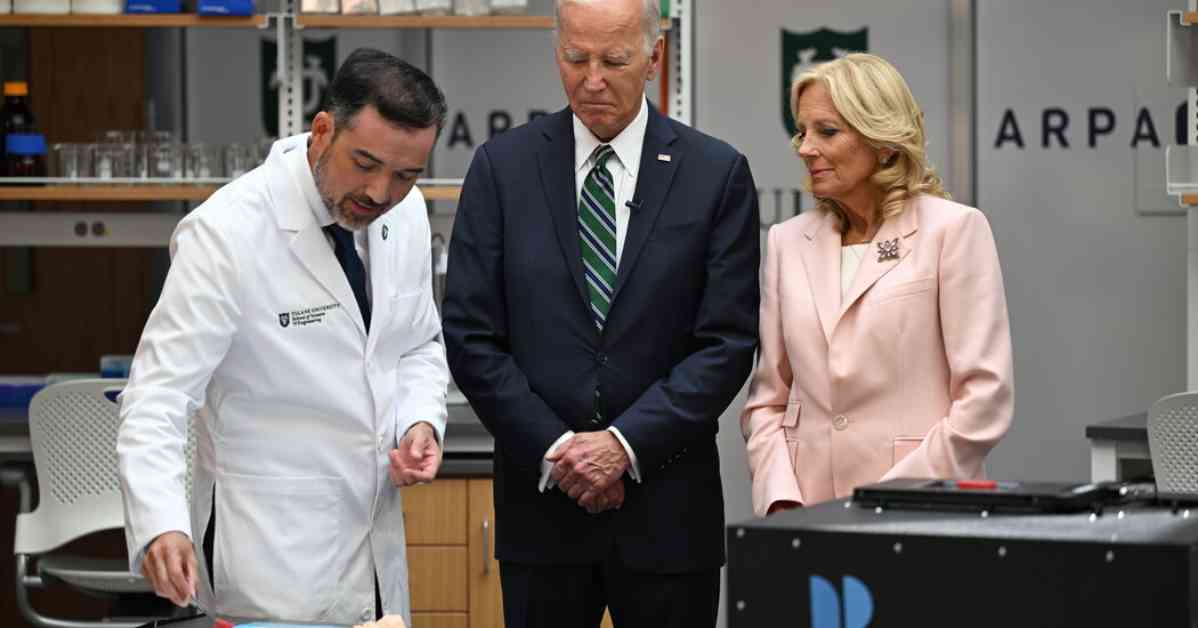
President Biden Awards $150 Million in Grants for Cancer Research
President Biden has long been passionate about advancing cancer research, a personal commitment that stems from the loss of his son Beau to an aggressive brain cancer in 2015. In a recent announcement, President Biden revealed that his administration is allocating $150 million in grants to eight research centers across the country. These grants are part of the administration’s ambitious cancer “moonshot” initiative, which aims to revolutionize cancer treatment and ultimately reduce cancer-related deaths.
During a speech at Tulane University, President Biden emphasized the importance of supporting cutting-edge research in the fight against cancer. He acknowledged the emotional and physical toll that cancer takes on individuals and families, highlighting the urgent need for innovative solutions. The $150 million in funding will enable these research centers to explore new methods of precision cancer surgery, with the goal of improving outcomes and reducing the burden on patients and their loved ones.
Expanding Access to Advanced Cancer Treatment
The grants awarded by President Biden will facilitate collaborations between researchers, medical professionals, and technology experts to develop novel approaches to cancer surgery. One such initiative involves the use of advanced imaging technology to ensure that cancer cells are completely removed during surgery, reducing the need for additional procedures. This innovative approach holds the potential to revolutionize cancer treatment and improve patient outcomes.
By investing in cutting-edge research, President Biden is signaling a renewed commitment to advancing cancer care and accelerating progress towards finding a cure. The administration’s focus on precision medicine and personalized treatment approaches reflects a shift towards more targeted and effective cancer therapies. These grants represent a significant step forward in the fight against cancer and demonstrate the administration’s dedication to improving the lives of cancer patients and their families.
Collaboration and Innovation in Cancer Research
President Biden’s announcement of $150 million in cancer research grants underscores the importance of collaboration and innovation in tackling complex medical challenges. By bringing together top research institutions and experts in the field, the administration is fostering a culture of cooperation and knowledge-sharing that is essential for driving progress in cancer research. The grants awarded to institutions such as Dartmouth College, Johns Hopkins University, and the University of California, San Francisco, reflect a commitment to supporting diverse approaches to cancer treatment and prevention.
The creation of the Advanced Research Projects Agency for Health (ARPA-H) in 2022 has provided a platform for driving biomedical innovation and accelerating the development of breakthrough technologies. Through initiatives like ARPA-H, the administration is empowering researchers to push the boundaries of what is possible in cancer research and treatment. The grants awarded to the eight research centers will fuel groundbreaking discoveries and pave the way for new advancements in cancer care.
In conclusion, President Biden’s announcement of $150 million in cancer research grants represents a significant investment in the future of cancer treatment and prevention. By prioritizing innovation, collaboration, and precision medicine, the administration is laying the groundwork for transformative changes in the field of oncology. As the nation continues to grapple with the impact of cancer, these grants offer hope for a future where cancer is no longer a life-threatening disease.