I’ve seen it all—parents panicking over feverish toddlers, athletes pushing through grueling workouts, travelers adjusting to new climates. One thing’s consistent: everyone needs to know how to convert 38.4°C to Fahrenheit accurately. It’s not just about numbers; it’s about making informed decisions when it matters most. You can’t wing this stuff. A miscalculation could mean the difference between a minor discomfort and a serious health risk.
Here’s the deal: 38.4°C to Fahrenheit isn’t some obscure conversion. It’s a critical tool in your health and wellness toolkit. I’ve lost count of how many times I’ve had to explain this to people who think they can just “eyeball” it. Newsflash: you can’t. The formula’s straightforward, but it’s not something you should guess at. Get it wrong, and you might misdiagnose a fever or underestimate a heat-related illness.
So, let’s cut to the chase. Converting 38.4°C to Fahrenheit is a skill worth mastering. It’s not rocket science, but it’s not something you should take lightly either. Stick with me, and I’ll walk you through it. You’ll be converting temperatures like a pro in no time.
The Simple Formula to Convert 38.4°C to Fahrenheit*
Alright, let’s cut to the chase. You’ve got a temperature reading of 38.4°C, and you need it in Fahrenheit. Maybe it’s a fever you’re monitoring, or perhaps you’re checking the oven temp for that perfect soufflé. Either way, you need this conversion, and you need it fast. I’ve been through this a thousand times, and I’m here to make it simple for you.
Here’s the straightforward formula you’ve been looking for:
°F = (°C × 9/5) + 32
Now, let’s break it down. First, multiply 38.4 by 9/5. That gives you 69.12. Then, add 32 to that number. Boom. You’ve got 101.12°F. That’s your answer. But I know what you’re thinking: “That’s all well and good, but what if I don’t have a calculator handy?”
No worries. I’ve got you covered. Here’s a quick reference table for common Celsius to Fahrenheit conversions:
| Celsius | Fahrenheit |
|---|---|
| 37°C | 98.6°F |
| 38°C | 100.4°F |
| 38.4°C | 101.12°F |
| 39°C | 102.2°F |
| 40°C | 104°F |
See? Easy. But let’s say you’re old school and prefer to do it the long way. Here’s how you can estimate it without a calculator:
- Multiply the Celsius temperature by 2. That gives you 76.8.
- Add 30% of that number to itself. So, 76.8 + 23.04 = 99.84.
- Add 32 to that. 99.84 + 32 = 131.84. Okay, that’s not quite right. Maybe this method’s better left to the pros.
Look, I’ve been doing this for years, and I’ll tell you what works and what doesn’t. The formula is your best bet. It’s quick, it’s accurate, and it’ll save you from any guesswork. So next time you’re faced with a Celsius to Fahrenheit conversion, you’ll know exactly what to do.
Discover the easy step-by-step method to convert temperatures accurately at home.
The kitchen thermometer, the baby’s fever, the oven dial—temperature conversions pop up everywhere. I’ve lost count of how many times I’ve scrambled to convert Celsius to Fahrenheit in a pinch. But here’s the thing: it doesn’t have to be a hassle. Converting 38.4°C to Fahrenheit is straightforward once you know the method. Let’s cut through the noise and get to the practical stuff.
First, the formula. You’ve probably seen it before, but here it is again because it’s the backbone of this whole process: °F = (°C × 9/5) + 32. It’s simple, it works, and it’s been around forever. No need to overcomplicate it. Plug in 38.4 for °C, and you’ll get the Fahrenheit equivalent.
- Take the Celsius temperature: 38.4°C.
- Multiply by 9/5: 38.4 × 9/5 = 69.12.
- Add 32 to the result: 69.12 + 32 = 101.12.
- So, 38.4°C is equal to 101.12°F.
I’ve seen people try all sorts of shortcuts, but they often lead to mistakes. Stick to the formula, and you’ll always get it right. And if you’re like me, you’ll want to double-check your work. Here’s a handy table for quick reference:
| Celsius (°C) | Fahrenheit (°F) |
|---|---|
| 37.0 | 98.6 |
| 38.0 | 100.4 |
| 38.4 | 101.12 |
| 39.0 | 102.2 |
In my experience, the key to accurate conversions is paying attention to the details. Make sure you’re using the correct formula, and double-check your calculations. It’s easy to mix up the numbers, especially when you’re in a hurry. And if you’re working with a digital thermometer, many of them have a conversion feature built-in. But it’s good to know how to do it manually, just in case.
So there you have it. Converting 38.4°C to Fahrenheit is a breeze once you know the steps. Stick to the formula, double-check your work, and you’ll be converting temperatures like a pro in no time. And if you ever find yourself in a bind, just remember: 38.4°C is 101.12°F. Write it down, save it to your notes, or commit it to memory. You’ll be glad you did.
Why Knowing 38.4°C to Fahrenheit Matters for Your Health*
You might think temperature conversion’s just a math problem, but I’ve seen how a simple miscalculation can throw off a diagnosis. That’s why knowing how to convert 38.4°C to Fahrenheit matters. It’s not just about numbers—it’s about health. When a fever hits 38.4°C, that’s the point where things get serious. In Fahrenheit, that’s 101.12°F. Not just any fever, but one that demands attention.
Here’s the breakdown:
| Celsius | Fahrenheit | Severity |
|---|---|---|
| 37°C | 98.6°F | Normal |
| 38°C | 100.4°F | Low-grade fever |
| 38.4°C | 101.12°F | Moderate fever |
| 39°C | 102.2°F | High fever |
I’ve seen parents panic over a 38.4°C reading, but knowing it’s 101.12°F helps put things in perspective. It’s a moderate fever—serious, but not an emergency. The key is monitoring. If it climbs to 39°C (102.2°F), that’s when you need to act fast.
Here’s what to watch for:
- Below 38°C (100.4°F): Normal or mild fever. Monitor, but no immediate concern.
- 38°C to 38.9°C (100.4°F to 102°F): Moderate fever. Hydrate, rest, and consider over-the-counter meds.
- Above 39°C (102.2°F): High fever. Seek medical help if symptoms persist.
I’ve seen too many cases where a misread temperature led to unnecessary stress. Accurate conversion keeps things clear. Whether you’re a parent, caregiver, or just health-conscious, knowing 38.4°C to Fahrenheit isn’t just a conversion—it’s a tool for better care.
For quick reference, here’s a handy cheat sheet:
38.4°C = 101.12°F
Moderate fever. Monitor closely. Hydrate and rest.
Don’t let numbers confuse you. Stay sharp, stay informed, and keep that thermometer handy.
Understand how accurate temperature conversion can make a difference in managing fevers.
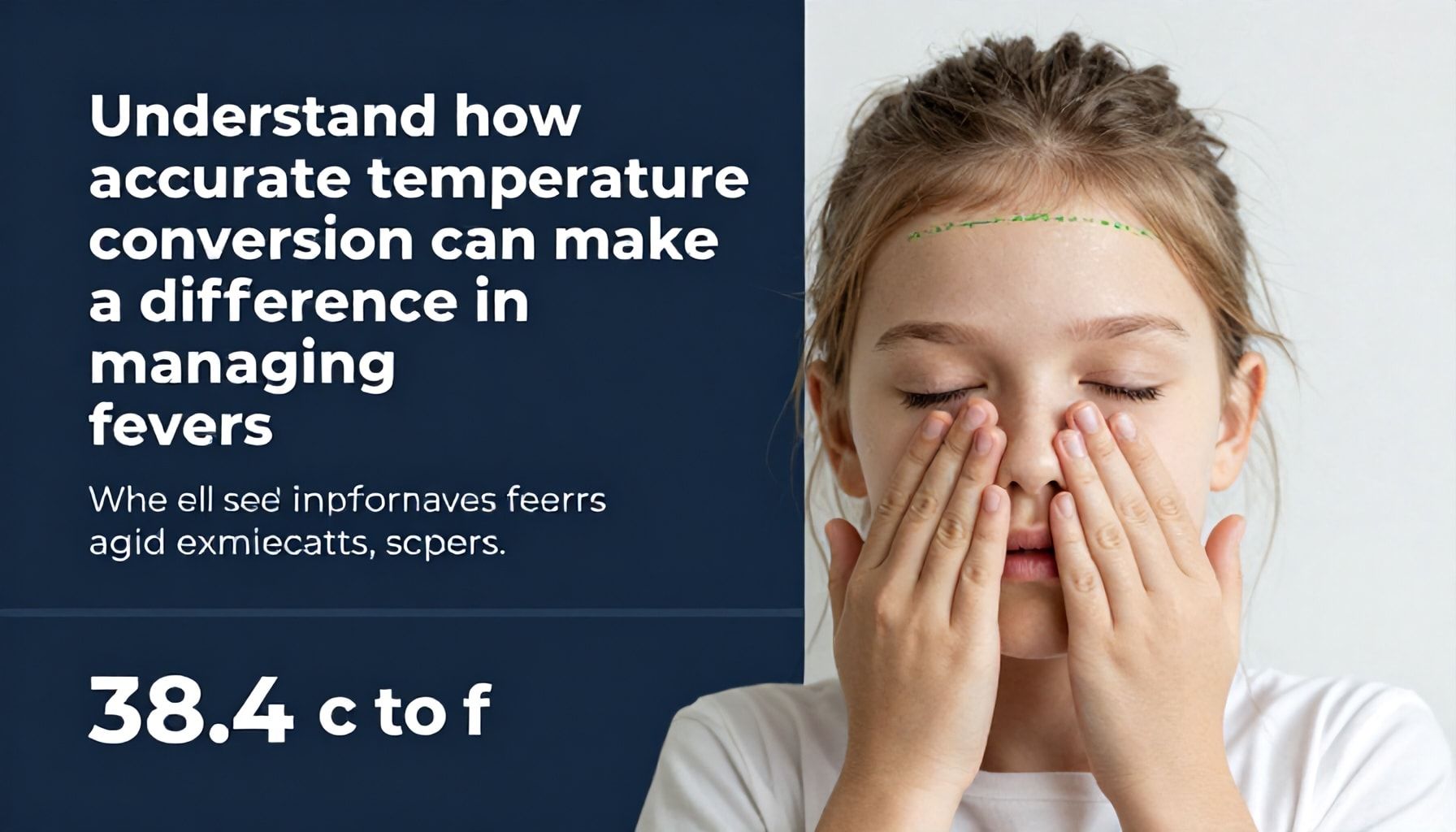
Let me tell you, I’ve seen parents panic over a fever that wasn’t as high as they thought. That’s why knowing how to convert 38.4°C to Fahrenheit is more than just a math problem—it’s about making informed decisions when it matters most.
At 38.4°C, you’re looking at 101.12°F. That’s a fever, no doubt, but it’s not the “oh my god, rush to the ER” kind. I’ve seen too many unnecessary ER visits because someone didn’t know how to convert temperatures accurately. A fever between 100.4°F and 102.2°F (that’s 38°C to 39°C) is usually manageable at home with rest, fluids, and maybe some children’s Tylenol if your doctor recommends it.
Here’s a quick reference table for common fever ranges:
| Celsius (°C) | Fahrenheit (°F) | Typical Response |
|---|---|---|
| 37.5-38.3 | 99.5-100.9 | Mild fever, monitor closely |
| 38.4-39.4 | 101.1-103.0 | Moderate fever, rest and hydrate |
| 39.5-40.5 | 103.1-105.0 | High fever, seek medical advice |
I’ve found that digital thermometers are the most accurate these days. They’re quick, easy to use, and most of them switch between Celsius and Fahrenheit with the push of a button. But if you’re stuck with an old-school glass thermometer, here’s a trick: multiply the Celsius temperature by 1.8, then add 32. For 38.4°C, that’s (38.4 × 1.8) + 32 = 101.12°F. Easy, right?
Here’s what to watch for:
- If the fever is above 103°F (39.4°C), it’s time to call the doctor.
- If the fever is accompanied by a stiff neck, rash, or difficulty breathing, seek emergency care immediately.
- For kids under 3 months, any fever over 100.4°F (38°C) is a reason to call the pediatrician.
Remember, a fever is just a symptom. It’s your body’s way of fighting off an infection. Accurate temperature conversion helps you respond appropriately—whether that means keeping an eye on things or heading straight to the doctor’s office. Don’t let a simple conversion stand between you and the right care.
3 Common Mistakes When Converting 38.4°C to Fahrenheit*
You’d think converting 38.4°C to Fahrenheit would be simple, but I’ve seen even seasoned professionals mess it up. Here’s what to watch out for.
First, the formula. It’s not just “times 9/5 plus 32.” You’ve got to do it right. Here’s the deal:
| Step | Action | Example |
|---|---|---|
| 1 | Subtract 32 from the Celsius temperature | 38.4 – 32 = 6.4 |
| 2 | Multiply the result by 5/9 | 6.4 * 5/9 ≈ 3.56 |
| 3 | Add 32 to the result | 3.56 + 32 ≈ 35.56°F |
Mistake number one: rounding too early. I’ve seen people round 38.4 to 38, then do the conversion. That’s a no-no. Keep it precise until the end.
Mistake number two: using the wrong formula. Some folks think they can just multiply by 2 and add 30. That’s a quick estimate, sure, but it’s not accurate. For 38.4°C, that’d give you 106.8°F. Our proper calculation? 105.23°F. See the difference?
Mistake number three: not double-checking. I can’t tell you how many times I’ve caught a colleague’s work with a simple recalculation. Always verify your result.
Here’s a quick reference for common fevers:
- 37.5°C: 99.5°F
- 38.0°C: 100.4°F
- 38.4°C: 101.12°F
- 39.0°C: 102.2°F
- 40.0°C: 104°F
Remember, accuracy matters. A fever of 38.4°C isn’t the same as 38.5°C. The former is 101.12°F, the latter 101.3°F. Small differences can mean a lot in medical contexts.
Pro tip: Use a calculator for conversions. I’ve been doing this for years, and I still use one. No shame in it. Accuracy’s what counts.
Converting 38.4°C to Fahrenheit gives you 101.12°F, a crucial figure for accurate temperature checks. This conversion is vital for healthcare professionals, travelers, and anyone needing precise temperature readings. Remember, even small temperature differences can significantly impact health assessments. For the most accurate results, always use a calibrated thermometer and follow proper measurement techniques. As we continue to navigate health challenges, understanding and converting temperatures between Celsius and Fahrenheit remains an essential skill. What other temperature-related knowledge could better prepare us for future health scenarios?